Achieving both detailed surface geometry and reliable spatial accuracy has always been a challenge in 3D scanning projects. Whether in industrial applications, reverse engineering, or cultural preservation, the need for high-precision data is crucial. As the demand for accuracy and efficiency in scanning continues to grow, 3D scanners with photogrammetry are emerging as a game-changer. By combining laser scanning and photogrammetry, these systems offer superior results, ensuring that every aspect of a scanned object is captured with unparalleled accuracy. ZG Technology’s integrated 3D scanning solutions are at the forefront of this technological leap, offering professionals in various industries a powerful tool for achieving high-quality 3D data with minimal effort.
Understanding 3D Scanning and Photogrammetry
What Is Laser Scanning?
Laser scanning is a technique used to capture the 3D geometry of physical objects. A 3D scanner with photogrammetry captures a high-resolution point cloud, which is essentially a collection of data points that represent the surface of an object. The laser scanner emits a laser beam that bounces off the object and returns to the sensor, providing precise measurements of the object's surface. These scans are highly accurate and are often used in applications that require detailed geometrical data.
What Is Photogrammetry?
Photogrammetry, on the other hand, is the science of using photographs to measure the shape, size, and position of objects. It involves taking multiple images of an object from various angles and then using software to combine these images into a 3D model. The key benefit of photogrammetry is its ability to capture texture and color, which is something laser scanning alone cannot do. By providing a visual representation of the object’s surface, photogrammetry enhances the overall scan, adding an extra layer of detail that would be difficult to achieve with laser scanning alone.
How Laser Scanning and Photogrammetry Work Together
When combined, laser scanning and photogrammetry offer unique strengths that enhance 3D modeling. Laser scanning provides highly accurate geometric data, while photogrammetry adds the texture and detail needed for a more complete digital representation. By integrating both technologies, users can generate 3D models that are not only geometrically precise but also visually rich, making them ideal for applications that require both high fidelity and realistic texture, such as in digital preservation or industrial design.
Why Integration Matters
Solving Alignment Drift Over Large Surfaces
One of the challenges in traditional 3D scanning is alignment drift, especially when scanning large surfaces or complex objects. As the scanner moves, the data captured at different points may not align perfectly, leading to gaps or inaccuracies in the final 3D model. 3D scanners with photogrammetry solve this issue by anchoring the laser scan data with photogrammetric reference points, ensuring better alignment across the entire surface. This integration helps maintain consistent accuracy, even for large or irregularly shaped objects.
Improving Volumetric Accuracy
Another major advantage of integrated photogrammetry is its ability to improve volumetric accuracy. Laser scanners capture precise geometrical data, but they often struggle with capturing large-scale volumes accurately. By combining photogrammetry, which provides spatial references from the images taken, the scanner can enhance the overall volumetric accuracy of the data. This leads to a more complete and reliable 3D model, making it easier to use the data for further analysis or production processes.
Reducing Reliance on External Gear
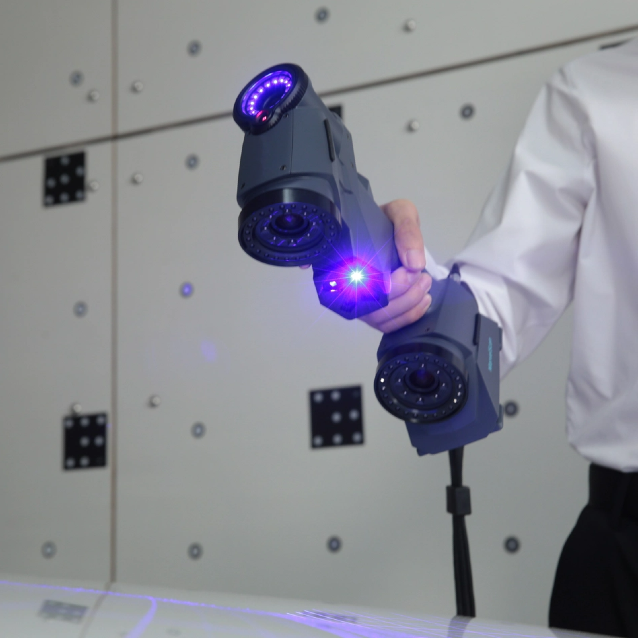
Traditional 3D scanning setups often require multiple pieces of equipment, such as external cameras or tracking devices, to capture and align data. However, 3D scanners with photogrammetry integrate both technologies into a single system, reducing the need for additional gear. This not only simplifies the setup but also minimizes the risk of equipment failure or misalignment, ensuring a smoother scanning experience.
Key Technical Benefits of Integrated Systems
Enhanced Data Accuracy
One of the most significant advantages of integrated photogrammetry is enhanced data accuracy. The combination of laser scanning and photogrammetry helps reduce cumulative errors that may arise when using either technology alone. Photogrammetry compensates for any inconsistencies in the laser scan data by adding visual references, which stabilizes tracking across the entire scanning process. This results in a more accurate final model, especially for larger or more intricate objects.
Richer Texture and Detail Capture
While laser scanning excels at capturing the geometry of an object, it does not provide detailed texture information. This is where photogrammetry comes in. By integrating photogrammetric images, 3D scanners with photogrammetry capture not only the surface geometry but also the textures, colors, and fine details of the object. This combination ensures that the final 3D model is not only accurate but also visually rich, providing a realistic representation of the scanned object.
Streamlined Workflow
Using both technologies simultaneously streamlines the scanning process. Instead of having to perform two separate scans—one for geometry and one for texture—an integrated system allows for both to be captured at the same time. This reduces duplication and post-processing steps, speeding up the workflow and ensuring that the final model is delivered in a fraction of the time.
Applications That Gain Most from Integrated Photogrammetry
Quality Control and Dimensional Inspection
In industries such as manufacturing and aerospace, 3D scanners with photogrammetry are invaluable for quality control and dimensional inspection. These industries require highly accurate data to ensure that parts and assemblies meet strict specifications. By combining laser scanning and photogrammetry, manufacturers can achieve the accuracy needed for critical measurements while also capturing the fine details of the surfaces being inspected. This is particularly useful for complex parts, such as engine components or aerospace structures, where precision is paramount.
Complex Reverse Engineering
Reverse engineering often involves recreating complex parts or objects that do not have existing CAD models. For these applications, 3D scanners with photogrammetry are ideal. The combination of high-resolution scanning and photogrammetric texture capture allows for a detailed reconstruction of the object, including both its geometry and appearance. Whether it's a car part or a piece of machinery, integrated scanning solutions provide the accuracy needed to recreate the original object.
Cultural Heritage and Preservation Documentation
3D scanners with photogrammetry are also widely used in cultural heritage and preservation projects. By capturing detailed 3D models of monuments, artifacts, and historical sites, professionals can preserve digital replicas for future generations. The ability to capture both geometry and texture in a single scan makes these systems particularly useful for documenting intricate details of sculptures, statues, or ancient buildings, which may be difficult or impossible to replicate with traditional methods.
Practical Implementation Tips
Best Practices for Combining Scanning with Photogrammetry
To get the most out of a 3D scanner with photogrammetry, it is important to follow best practices. Ensure that the object being scanned has adequate texture and features for photogrammetry to work effectively. If scanning smooth or reflective surfaces, additional measures, such as applying a temporary powder or coating, may be required to improve the photogrammetric results. Also, ensure that the lighting conditions are suitable for capturing high-quality images, as poor lighting can reduce the effectiveness of photogrammetry.
Environmental Considerations
Lighting and surface texture play a crucial role in the success of photogrammetry. In environments with uneven lighting or complex textures, ensure that the photogrammetry settings are optimized to capture the best possible data. Consistent lighting and careful positioning of the scanner will ensure better results.
How Integrated Solutions Improve Throughput
The integration of both technologies into a single system improves throughput by reducing the time spent on setup and post-processing. Since both geometric and textural data can be captured simultaneously, the scanning process becomes much faster, allowing for more efficient production cycles and reduced downtime.
Comparison with Standalone Systems
While traditional laser-only 3D scanners excel at capturing geometry, they often lack the ability to capture fine details and textures. 3D scanners with photogrammetry, on the other hand, combine both geometric accuracy and visual detail in one streamlined solution. In terms of workflow efficiency, integrated systems outshine standalone solutions by reducing the need for multiple scans and post-processing steps. They also provide a more complete and accurate representation of the object, making them the superior choice for applications that require both precision and detail.
Conclusion
3D scanners with photogrammetry represent the future of 3D scanning, offering a powerful combination of laser scanning and photogrammetry to deliver superior results. By integrating both technologies, users can achieve highly accurate geometric data while also capturing intricate textures and details. This integration improves workflow efficiency, reduces setup time, and ensures that the final 3D model is both precise and visually rich. For professionals seeking accurate, fast, and richly detailed 3D scan datasets, 3D scanners with photogrammetry provide the ideal solution. Contact us today to learn more about how our integrated scanning solutions can enhance your projects.
FAQ
1. How do 3D scanners with photogrammetry improve the scanning process?
3D scanners with photogrammetry combine laser scanning and photogrammetry to provide both accurate geometry and detailed textures in a single scan, reducing post-processing time and improving overall scan quality.
2. What industries benefit the most from integrated photogrammetry?
Industries such as manufacturing, aerospace, reverse engineering, and cultural heritage preservation benefit the most from 3D scanners with photogrammetry, as they require both geometric precision and detailed surface data.
3. Can 3D scanners with photogrammetry capture textures on smooth or reflective surfaces?
Yes, 3D scanners with photogrammetry can capture textures on smooth or reflective surfaces, but additional measures such as temporary coatings may be necessary to improve the effectiveness of photogrammetry in these conditions.
4. How does photogrammetry enhance the accuracy of 3D scanning?
Photogrammetry enhances the accuracy of 3D scanning by providing spatial references from multiple images, which helps to stabilize the alignment of the laser scan data and reduce cumulative errors.


