In traditional 3D scanning, one of the biggest challenges faced by engineers and technicians is the reliance on manual markers for alignment and measurement accuracy. This method is often time-consuming, requiring precise placement of markers across the surface of the object being scanned, which can introduce errors and extend setup times. Fortunately, modern laser scanners have evolved to eliminate the need for these markers, enabling Simplified 3D Scanning. These advancements not only speed up the scanning process but also improve the overall accuracy and efficiency of 3D data capture. This article explores how modern laser scanners make the scanning process more streamlined, precise, and adaptable to a variety of complex applications.
Understanding Manual Markers in 3D Scanning
Why Markers Were Used Historically
In the past, 3D scanning relied heavily on the use of manual markers for alignment and positioning. Markers, which are typically adhesive or reflective targets, are placed on the object being scanned to provide reference points for the scanner. These markers help the scanner track the position and orientation of the object, ensuring that the data collected is accurate and aligned.
This technique was essential in the early days of 3D scanning, especially when scanning larger or more complex objects where precise alignment was difficult to achieve without markers. The markers provided a clear, visual reference for the scanner, allowing it to create accurate 3D models. However, while effective, this process was far from ideal, as it introduced several significant pain points.
Pain Points: Marker Placement, Surface Damage, and Preparation Time
One of the primary drawbacks of using markers is the time and effort required to place them correctly. For large or intricate objects, this process could take hours, leading to delays in the scanning workflow. Additionally, markers must be placed in specific positions to ensure the accuracy of the scan, which means that any mistake in marker placement can result in flawed data.
Moreover, markers can cause surface damage. When used on delicate or soft materials, adhesive markers can leave residue or even damage the surface upon removal. In some cases, the markers may not adhere properly to certain surfaces, such as highly reflective or irregular shapes, which can further complicate the scanning process.
Another issue is the preparation time involved in setting up the markers. Before the scanning process can even begin, all the markers must be carefully positioned, requiring manual labor and potentially disrupting workflows. These inefficiencies ultimately lead to increased costs and longer turnaround times.
How Modern Laser Scanners Simplify 3D Capture
Inside-Out and Optical Tracking Technologies for Auto Positioning
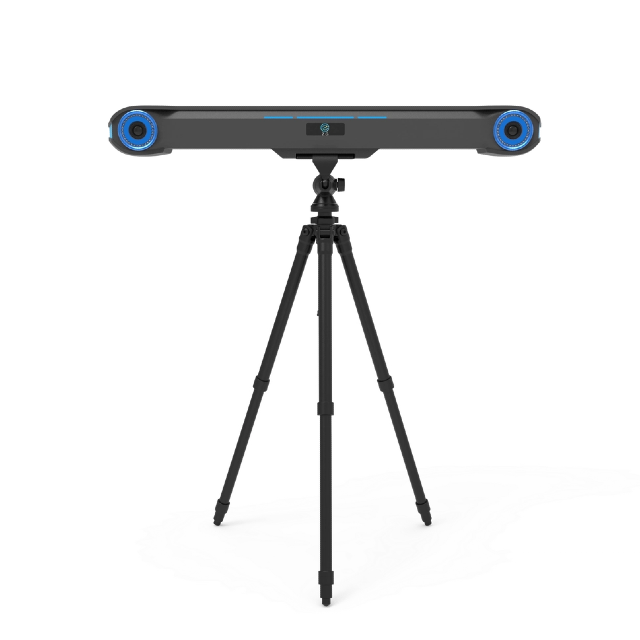
Modern laser scanners have overcome the need for manual markers by incorporating inside-out and optical tracking technologies. These technologies enable the scanner to automatically detect the position and orientation of the object being scanned without requiring any external markers.
Inside-out tracking works by using cameras and sensors on the scanner to track the environment and scan the object from multiple angles. The system continuously adjusts its position based on the scanned data, allowing it to create accurate 3D models without the need for physical reference points. This technology simplifies the scanning process by eliminating manual setup and ensuring continuous, real-time data capture.
Optical tracking is another key technology used in Simplified 3D Scanning. This system uses optical sensors to detect the object's movement and orientation in space, providing accurate measurements without requiring markers. By leveraging these technologies, modern scanners can create highly detailed 3D models without the need for labor-intensive marker placement.
Built-In Photogrammetry and Camera Fusion Techniques
In addition to inside-out and optical tracking, modern laser scanners often incorporate photogrammetry and camera fusion techniques to further simplify the scanning process. Photogrammetry involves taking multiple photographs of the object from different angles and using software to convert these images into accurate 3D models. Camera fusion techniques combine data from different sensors, such as infrared cameras, to create a more detailed and precise model.
These technologies work together to eliminate the need for manual markers by automating the alignment and tracking processes. The result is faster, more efficient scanning with minimal manual intervention.
Auto Alignment and Real-Time Tracking Enhancements
Another critical advancement in Simplified 3D Scanning is the ability to automatically align data in real time. Modern scanners come equipped with advanced algorithms that automatically align and stitch together the scanned data as it is captured. This real-time alignment ensures that the final 3D model is accurate and complete, without the need for post-processing or manual corrections.
Additionally, real-time tracking allows the scanner to continuously adjust its position during the scan, ensuring that the data remains aligned as the object is scanned from different angles. This feature significantly reduces the risk of errors and inconsistencies in the final model, making the scanning process more reliable and efficient.
Benefits of Simplified 3D Scanning Workflows
Less Training Required for Operators
One of the primary benefits of Simplified 3D Scanning is that it reduces the amount of training required for operators. Since the scanner no longer requires manual marker placement, operators can focus on capturing data rather than spending time on setup and alignment. This simplification of the process makes it easier for new users to learn how to operate the scanner, reducing the learning curve and increasing productivity.
Faster End-to-End Measurement
The elimination of markers significantly speeds up the scanning process. With traditional marker-based systems, a significant portion of the time is spent placing and adjusting markers before the scan can even begin. In contrast, modern laser scanners can start capturing data immediately, allowing for faster end-to-end measurements. This is particularly valuable in industries where time is of the essence, such as automotive manufacturing, aerospace, and construction.
By streamlining the scanning process, Simplified 3D Scanning helps companies save time and increase throughput, ultimately improving operational efficiency.
Scanning Complex or Reflective Surfaces with Fewer Artifacts
Simplified 3D Scanning also allows for the scanning of complex or reflective surfaces with fewer artifacts. Traditional marker-based systems struggle with highly reflective or irregular surfaces, as the markers may not adhere properly or the scanner may fail to capture accurate data. With marker-free systems, these surfaces can be scanned without the limitations imposed by physical markers, leading to more accurate and detailed 3D models.
For example, in the field of heritage preservation, where delicate or irregularly shaped artifacts need to be scanned, modern laser scanners offer a non-invasive and efficient solution that avoids the need for markers that could damage the objects.
Key Scenarios That Benefit Most from Simplification
Reverse Engineering Complex Assemblies
One of the most significant applications of Simplified 3D Scanning is reverse engineering complex assemblies. In industries such as automotive, aerospace, and manufacturing, reverse engineering is often required to replicate parts or improve existing designs. The ability to scan complex assemblies quickly and accurately without the need for markers makes the process faster and more efficient.
By eliminating manual marker placement and using optical tracking, 3D laser scanners can capture detailed geometric data from complex parts, allowing engineers to create precise 3D models for further analysis or manufacturing.
On-Site Measurements in Construction, Infrastructure, and Art Preservation
Simplified 3D Scanning is also ideal for on-site measurements in industries such as construction, infrastructure, and art preservation. Whether measuring large structures, scanning historical artifacts, or documenting construction progress, modern laser scanners provide accurate, real-time data without the need for markers. This is especially important in environments where time and accuracy are critical, such as when capturing measurements of buildings or monuments.
In construction and infrastructure projects, the ability to scan large areas quickly and accurately ensures that measurements are precise and that the project stays on track. Similarly, in art preservation, the non-invasive nature of 3D scanning allows for the detailed capture of delicate works of art without causing any damage.
Quality Inspection Without Surface Alteration
Simplified 3D Scanning is also beneficial for quality inspection applications where surface alteration is not an option. Traditional marker-based systems often require the use of adhesive markers, which can alter the surface of the object being scanned. In contrast, marker-free systems eliminate this risk, allowing for accurate inspection without causing any damage to the object. This is especially useful in industries like electronics, aerospace, and automotive, where even the slightest damage to a component can result in costly rework or failure.
Comparison: Manual Markers vs. Modern Marker-Free Techniques
Workflow Steps Reduction
When comparing manual markers with modern marker-free techniques, one of the most significant differences is the reduction in workflow steps. Traditional marker-based systems require the placement and adjustment of markers, which can be time-consuming and prone to errors. With marker-free scanning, these steps are eliminated, leading to a more efficient workflow.
Error-Rate Improvements
Another key advantage of Simplified 3D Scanning is the reduction in error rates. Manual marker placement is susceptible to human error, which can lead to inaccurate scans or misalignment. Marker-free systems, with their automatic tracking and alignment capabilities, minimize the risk of errors, ensuring that the final 3D model is accurate and reliable.
Case Examples Highlighting Time Savings
In industries like automotive and aerospace, time is of the essence. The use of marker-free 3D scanning has significantly reduced the time required for data capture, enabling companies to speed up their design, testing, and production processes. By eliminating manual marker placement and reducing setup time, modern scanners allow for quicker turnaround times and faster decision-making.
Conclusion
Simplified 3D Scanning is revolutionizing the way industries approach data capture and measurement. By eliminating the need for manual markers, modern laser scanners enable faster, more accurate scanning with fewer errors and less preparation time. Whether in reverse engineering, construction, or quality control, marker-free 3D scanning provides a streamlined solution that improves productivity, reduces costs, and enhances the accuracy of measurements.
If you’re looking for a reliable and efficient way to streamline your scanning processes, ZG Technology offers advanced Simplified 3D Scanning solutions that can help you achieve faster and more reliable results. For more information, contact us today.
FAQ
1. What are the advantages of marker-free 3D scanning?
Marker-free 3D scanning eliminates the need for manual marker placement, reducing setup time, minimizing errors, and allowing for more accurate scans, particularly on complex or reflective surfaces.
2. How does modern laser scanning simplify 3D capture?
Modern laser scanners use optical tracking and photogrammetry to automatically capture data without the need for markers, enabling faster and more efficient scanning.
3. Can simplified 3D scanning be used for reverse engineering?
Yes, simplified 3D scanning is ideal for reverse engineering complex assemblies, as it allows for fast and accurate data capture without manual marker placement.
4. How does marker-free scanning improve the quality inspection process?
Marker-free scanning eliminates the need for surface-altering markers, ensuring that quality inspections are performed without damaging the object being inspected.


