Introduction
Laser scanning technology is revolutionizing industries like architecture, construction, and surveying. But how far can a laser scanner truly reach? Understanding a scanner's range is crucial to choosing the right one for your project.
In this article, we will explore the different types of laser scanners, what affects their range, and their common applications. You’ll learn how to choose the best scanner for your needs.
What Is a Laser Scanner?
A laser scanner is a tool that uses laser beams to capture three-dimensional data of objects and environments. The device measures distances by emitting laser pulses and calculating the time it takes for them to return after hitting an object. This process results in a 3D point cloud that accurately represents the scanned area or object. Laser scanners can capture a wide range of surfaces and structures, from small parts in industrial manufacturing to large-scale terrains in surveying.
Laser scanners come in different types, each designed to meet specific needs based on factors such as range, accuracy, and the nature of the environment being scanned. The ability to measure distances over various ranges is crucial for industries such as construction, architecture, archaeology, and geospatial mapping.
Types of Laser Scanners
Short-Range Laser Scanners
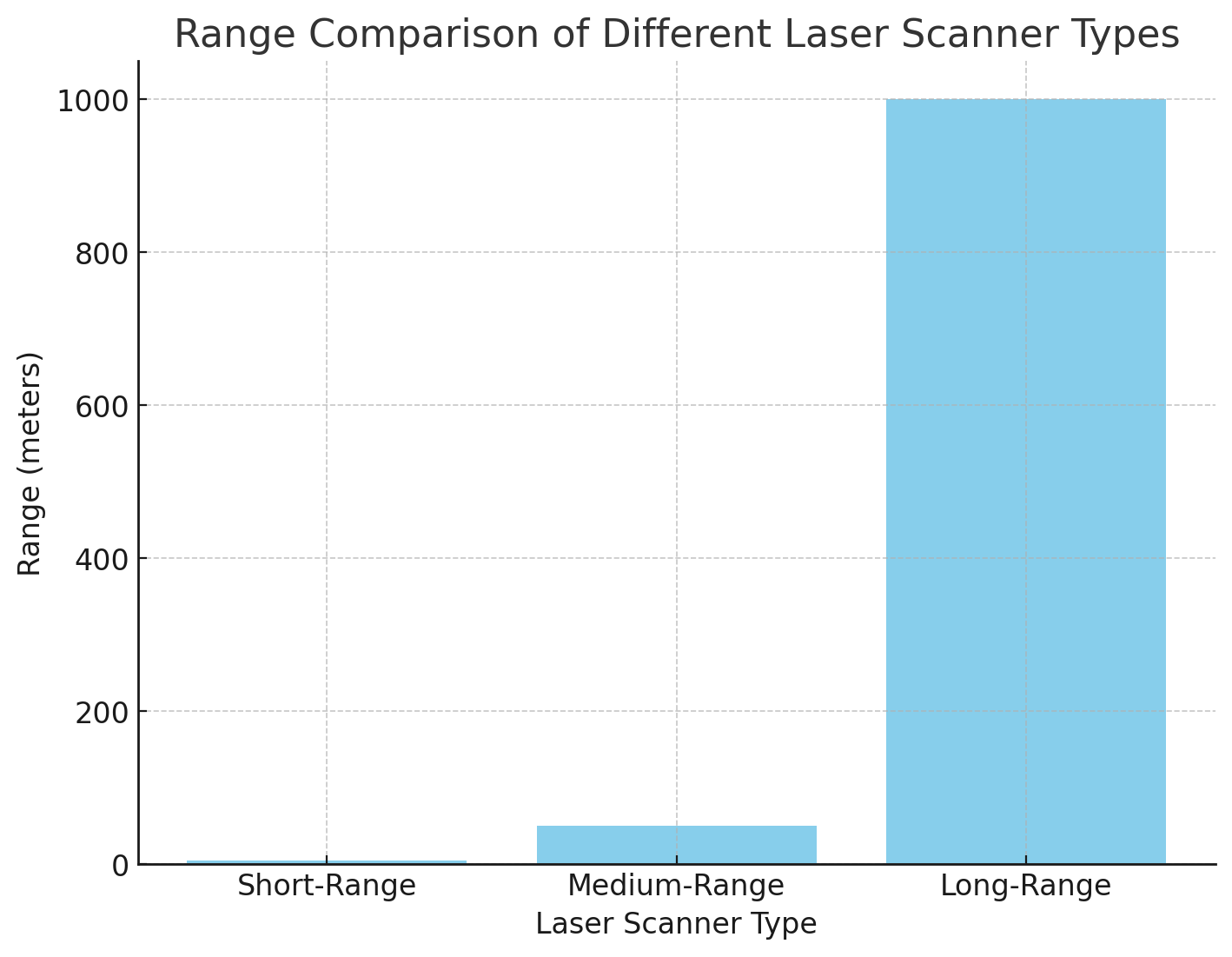
Short-range laser scanners are typically used for detailed scanning of small objects or areas. These scanners are often found in applications like quality control, reverse engineering, and industrial design. They employ triangulation methods where a laser beam is projected onto an object, and the reflection is captured by a camera positioned at a known distance from the laser source. The typical range of these scanners is between 0.1 to 5 meters.
These scanners are ideal for capturing small objects in high detail but are not suitable for larger environments or objects.
Medium-Range Laser Scanners
Medium-range laser scanners are used for capturing larger areas or objects. They are commonly used in automotive and aerospace industries, as well as in architecture and construction. These scanners typically employ time-of-flight (TOF) technology, where the scanner measures the time it takes for a laser pulse to travel to the object and return. Medium-range scanners can cover distances ranging from a few meters up to around 50 meters.
These scanners strike a balance between range and detail, making them perfect for scanning larger components or building sections.
Long-Range Laser Scanners
Long-range laser scanners are designed for large-scale applications such as surveying, mining, and topographical mapping. These scanners are equipped with powerful lasers and advanced technology to accurately capture data from several hundred meters to several kilometers. They often use time-of-flight technology or phase-shift technology, which allows for precise measurements over long distances. Long-range scanners are essential for capturing vast terrains or large infrastructures like bridges and highways.
These scanners are invaluable for projects that require data from a broad geographic area or need to cover long distances.
Scanner Type | Range | Common Applications |
Short-Range 3D Scanner | 0.1 to 5 meters | Quality control, reverse engineering, small object scanning |
Medium-Range 3D Scanner | Up to 50 meters | Automotive, aerospace, architecture |
Long-Range 3D Scanner | Up to several kilometers | Surveying, mining, topographical mapping |
Handheld 3D Scanner | 0.1 to 3 meters | Small object scanning, intricate details |
Terrestrial 3D Scanner | Up to 1 kilometer or more | Large-scale outdoor scanning |
Aerial & Mobile Scanner | Up to several kilometers | Drones or vehicles for rapid data capture |
Factors Affecting Laser Scanner Range
Laser Power and Wavelength
The power and wavelength of a laser significantly impact the range of a laser scanner. Higher power lasers can travel longer distances and penetrate more deeply into surfaces. Additionally, the wavelength of the laser plays a role in how it interacts with different surfaces. For example, lasers with a shorter wavelength can be absorbed by certain materials, limiting their range.
Surface Reflectivity
The reflectivity of the surface being scanned is another factor that can affect the scanner’s range. Highly reflective surfaces, such as metals or glossy materials, can be scanned from greater distances compared to dark, matte surfaces, which absorb more laser light. This can influence the scanner’s ability to capture accurate data, especially at longer distances.
Environmental Conditions
Environmental factors, including lighting, weather, and atmospheric conditions, can all impact the performance of a laser scanner. For instance, bright sunlight can interfere with the laser beam, reducing the effective scanning range. Similarly, rain, fog, or dust can scatter the laser light and result in decreased scanning performance. It’s essential to consider these factors when selecting a scanner for outdoor or challenging environments.
Resolution and Accuracy Requirements
While scanning range is important, the resolution and accuracy of the scan are also critical factors. In some cases, achieving high accuracy may require scanning at shorter distances to ensure that the finer details of an object or environment are captured. This can limit the effective range of a scanner depending on the application’s precision requirements.
Factor | Impact on Range |
Laser Power and Wavelength | Higher power allows for longer scanning distances. The wavelength affects how well the laser can penetrate certain surfaces. |
Surface Reflectivity | Highly reflective surfaces (e.g., metals) allow for longer scanning ranges compared to matte or dark surfaces. |
Environmental Conditions | Weather conditions like fog, rain, or sunlight can reduce the scanner's effective range. |
Resolution and Accuracy | Higher accuracy often reduces the effective range. To ensure precision, scanners may need to operate at shorter distances. |
Typical Laser Scanner Ranges
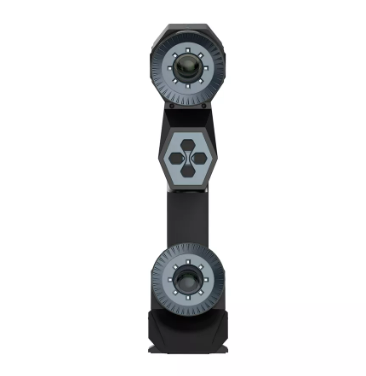
Handheld 3D Laser Scanners
Handheld 3D laser scanners are portable devices ideal for scanning small to medium-sized objects. These scanners typically have a range of 0.1 to 3 meters, making them suitable for detailed scanning of individual components or small objects. They are commonly used in reverse engineering, industrial inspection, and quality control.
Stationary Laser Scanners
Stationary laser scanners are fixed in position and used for scanning larger areas or objects. These scanners can be categorized into short-range, medium-range, and long-range scanners. Short-range scanners typically scan up to 5 meters, while medium-range scanners can capture data up to 50 meters. Long-range stationary scanners can scan up to several hundred meters, ideal for large-scale projects or surveying tasks.
Terrestrial Laser Scanners
Terrestrial laser scanners are designed for surveying large-scale environments such as cities, terrains, and construction sites. These scanners can have ranges of over 1 kilometer and are often used for capturing data from extensive outdoor environments. They use powerful lasers and advanced scanning technologies to provide accurate measurements over vast distances.
Aerial and Mobile Laser Scanners
Aerial laser scanners, often mounted on drones, and mobile laser scanners, typically mounted on vehicles, are used for rapid scanning over large areas. These scanners can cover several kilometers depending on the altitude and speed of the platform. They are widely used for topographical mapping, land surveys, and large infrastructure scanning.
Applications and Range Requirements
Surveying and Geospatial Mapping
Surveying and geospatial mapping require long-range scanners with the ability to capture large terrains or structures. A typical laser scanner for this purpose needs a range of at least 100 meters, but in some cases, scanners capable of several kilometers are used. These scanners are crucial for creating detailed maps, conducting land surveys, and monitoring geographic changes.
Architecture and Construction
In architecture and construction, laser scanners are used to capture the dimensions of buildings, sites, and infrastructure. For these applications, scanners with ranges from 5 meters to over 100 meters are often used. These scanners provide detailed data to help with project planning, design, and structural documentation.
Automotive and Aerospace Industries
The automotive and aerospace industries often use laser scanners for tasks like quality control, reverse engineering, and component fitting. These industries typically require scanners with ranges between 0.1 to 30 meters, as the focus is usually on detailed inspection rather than long-range scanning.
Application | Required Range | Typical Scanner Type |
Surveying & Geospatial Mapping | 100 meters to several kilometers | Long-range 3D scanner |
Architecture & Construction | 5 to 100 meters | Stationary 3D scanners |
Automotive & Aerospace | 0.1 to 30 meters | Handheld or medium-range 3D scanners |
How to Choose the Right Laser Scanner Based on Range
When selecting a laser scanner, it’s important to consider several factors such as the size of the object or area being scanned, the required level of detail, and the environment. For large outdoor projects, long-range scanners are ideal, while for detailed inspections, short- or medium-range scanners may be more suitable. Understanding the range requirements and matching them with the appropriate scanner type is crucial for ensuring that the project is completed efficiently and accurately.
Scanner Type | Range | Common Use Cases | Typical Accuracy |
Short-Range Scanner | 0.1 to 5 meters | Small object scanning, detailed inspections | High precision, limited distance |
Medium-Range Scanner | Up to 50 meters | Automotive, aerospace, architecture | Moderate accuracy, moderate range |
Long-Range Scanner | Up to several kilometers | Large-scale surveying, topographical mapping | Lower accuracy at long distances |
Conclusion
The range of a laser scanner is crucial for determining its application. Short-range scanners are perfect for small object inspections, while long-range scanners are needed for large-scale projects like surveying. Understanding range factors and selecting the right scanner ensures businesses use the best tool. As technology advances, scanners' range and accuracy will continue to improve. For high-range needs, products from companies like ZG Technology offer precise measurement solutions that add significant value to projects.
FAQ
Q: How far can a 3D laser scanner scan?
A: The range of a 3D laser scanner depends on its type. Short-range scanners can capture data up to 5 meters, while long-range models can scan up to several kilometers.
Q: What factors affect a 3D laser scanner's range?
A: Factors include laser power, surface reflectivity, environmental conditions, and the scanner's resolution. These elements all influence how far a scanner can effectively capture data.
Q: Can a 3D laser scanner be used for large-scale mapping?
A: Yes, long-range 3D laser scanners are ideal for large-scale applications like surveying and topographical mapping, with ranges extending up to several kilometers.
Q: What is the typical range of handheld 3D laser scanners?
A: Handheld 3D laser scanners typically have a range of 0.1 to 3 meters, making them suitable for small object scanning and detailed inspections.
Q: How do different 3D laser scanners compare in range?
A: Short-range scanners are effective for close-ups, while medium to long-range 3D laser scanners are needed for capturing larger environments, such as architectural structures and outdoor terrains.

