In industrial and manufacturing environments, accuracy is paramount. Measurement tools, whether traditional or cutting-edge, play a critical role in ensuring precision during production, quality control, and design. Among the tools available today, Professional Metrology-grade 3D Laser Scanners have emerged as one of the most advanced solutions, providing precise, efficient, and data-rich measurements. These scanners have significantly transformed industries such as automotive, aerospace, and manufacturing, offering speed and accuracy that traditional methods often struggle to match.
In this article, we will compare Professional Metrology-grade 3D Laser Scanners to traditional measurement tools, discussing the differences in terms of accuracy, speed, data integration, and overall efficiency. By understanding these key differences, businesses can make more informed decisions when choosing the right measurement solutions for their needs.
What Are Professional Metrology-grade 3D Laser Scanners?
A Professional Metrology-grade 3D Laser Scanner is an advanced measurement tool that captures precise three-dimensional data of objects using laser technology. These scanners are designed for high-accuracy measurements, often within microns, making them ideal for industries where precision is critical.
Metrology-grade scanners are specifically built to meet the stringent requirements of industries that rely on high-quality measurements, such as aerospace, automotive, and heavy manufacturing. Unlike traditional measurement tools, which rely on direct physical contact with the object, 3D laser scanners capture the entire surface of an object using laser beams, resulting in highly detailed and accurate 3D models.
The Significance of Metrology-grade Quality
Metrology-grade scanners are engineered for absolute precision and reliability. They are subject to rigorous standards and certification, ensuring that they provide accurate, repeatable measurements. These scanners are indispensable for businesses that require precise measurements for reverse engineering, quality control, or product design.
Traditional Measurement Tools: Overview and Limitations
Before the advent of Professional Metrology-grade 3D Laser Scanners, businesses relied heavily on traditional measurement tools. These included manual tools such as calipers, micrometers, and coordinate measuring machines (CMM). While these tools have served industries for decades, they come with inherent limitations.
Traditional measurement tools typically require direct physical contact with the object, which can lead to human error, limited measurement range, and a lack of flexibility for measuring complex or irregular shapes. Additionally, these tools often cannot provide 3D data, which is becoming increasingly essential in modern manufacturing processes.
Common Traditional Measurement Tools
Calipers: Used for measuring the length, depth, and thickness of an object.
Micrometers: Offer high precision for measuring small dimensions such as the thickness of materials or diameters of small parts.
CMM (Coordinate Measuring Machine): A stationary device used to measure the physical geometrical characteristics of an object.
Limitations of Traditional Measurement Tools
Traditional Tool | Limitation |
Calipers | Only measures external dimensions, limited to simple geometries. |
Micrometers | High precision but not suitable for large parts or complex geometries. |
CMM | Expensive, stationary, and time-consuming, especially for large or intricate parts. |
While traditional tools remain useful for simple measurements, they often struggle when it comes to measuring complex parts or large objects. This is where Professional Metrology-grade 3D Laser Scanners provide a significant advantage.
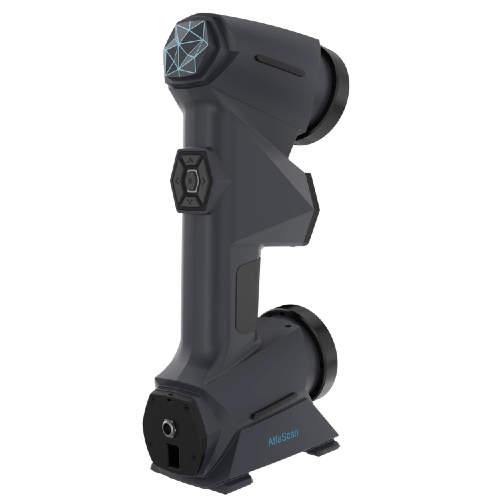
Key Differences Between Metrology-grade 3D Laser Scanners and Traditional Measurement Tools
1. Accuracy and Precision
The core strength of Professional Metrology-grade 3D Laser Scanners lies in their unmatched accuracy and precision. Unlike traditional measurement tools, which rely on manual intervention and physical contact, 3D laser scanners can measure entire surfaces at once with extremely high accuracy, typically within microns. This is crucial in industries where even the smallest deviation from the required measurements can result in costly errors.
Accuracy in metrology-grade scanning refers to how close the measurements are to the actual dimensions of the object. Resolution is also important and refers to how finely the scanner can capture details on an object’s surface.
In contrast, traditional tools like calipers and micrometers measure one point at a time, making them more prone to human error and inconsistencies. Moreover, CMMs are generally slower and require more time to measure large or complex objects compared to 3D laser scanners.
2. Measurement Speed
Speed is another significant advantage of Professional Metrology-grade 3D Laser Scanners over traditional tools. A 3D laser scanner can capture an entire surface of an object in a matter of seconds or minutes, depending on the object’s complexity and size. This speed is crucial for industries with high production volumes or tight deadlines, such as automotive and aerospace manufacturing.
On the other hand, traditional tools like calipers or micrometers can only measure specific points, making the process slow and labor-intensive. CMMs, while faster than manual tools, still require a significant amount of time to measure even moderately sized components.
3. Range and Flexibility
Another advantage of 3D laser scanners is their ability to measure objects of virtually any size or complexity without physical contact. This allows for more flexibility in measuring intricate geometries, such as those found in automotive or aerospace components.
Traditional measurement tools, however, are limited by their physical range and the need for direct interaction with the object. For example, calipers are only suitable for small, simple objects, and CMMs may struggle with very large parts or those with complex shapes.
3D laser scanners can scan large objects quickly, capturing vast amounts of data in one scan, and are ideal for measuring complex, hard-to-reach areas that traditional tools cannot handle efficiently.
4. Data Integration and Analysis
One of the most powerful features of Professional Metrology-grade 3D Laser Scanners is their ability to generate 3D models, which can be easily integrated into CAD software for further analysis or design modifications. This seamless integration enables businesses to create, edit, and optimize parts in a digital environment, enhancing the entire product development cycle.
Traditional measurement tools do not provide data in digital form and require manual entry or additional processing to integrate data into a digital workflow. The 3D laser scanner eliminates this step by providing ready-to-use data for analysis, inspection, or modification.
5. Portability and Ease of Use
Professional Metrology-grade 3D Laser Scanners are also much more portable and easier to use than traditional measurement tools. Many 3D laser scanners are lightweight and designed for easy mobility, allowing them to be used on-site or in the field without the need for a dedicated workstation. Additionally, these scanners often feature intuitive software interfaces, making them accessible even to operators with limited technical expertise.
Traditional tools, on the other hand, can be cumbersome to use, requiring precise handling and significant training to avoid measurement errors. Additionally, tools like CMMs are large, stationary, and generally not suitable for mobile applications.
Why Transition to Metrology-grade 3D Laser Scanners?
Switching from traditional measurement tools to Professional Metrology-grade 3D Laser Scanners can significantly enhance the efficiency, accuracy, and productivity of your operations. Here’s why:
Increased Efficiency: Faster scanning and data collection reduce the overall time spent on measurement tasks, which accelerates production and testing processes.
Cost Savings: With higher accuracy and fewer errors, 3D laser scanners minimize costly mistakes and the need for rework, ultimately saving your business money.
Better Integration: The ability to directly integrate measurement data into CAD software improves design and testing workflows, leading to quicker product development.
Improved Quality Control: Continuous, high-accuracy measurement allows for better quality control and ensures that products meet the required specifications before reaching the market.
Conclusion
While traditional measurement tools have their place, Professional Metrology-grade 3D Laser Scanners offer undeniable advantages in terms of accuracy, speed, flexibility, and data integration. By adopting 3D laser scanning technology, businesses can enhance their measurement processes, boost product quality, and maintain a competitive edge in today’s dynamic market. Transitioning to 3D scanning not only improves efficiency but also leads to long-term cost savings, ultimately transforming business operations.
At ZG Technology, we understand the importance of precision in industries like automotive, aerospace, and manufacturing. Our Professional Metrology-grade 3D Laser Scanners provide advanced solutions tailored to meet the needs of modern businesses. If you are looking to enhance your measurement capabilities, we invite you to explore our range of 3D laser scanners. Our team is ready to assist you in finding the right solution for your needs, helping you improve operational efficiency and achieve long-term success. Contact us today to learn more about how our advanced technology can support your business.
FAQ
1. What makes a Professional Metrology-grade 3D Laser Scanner more accurate than traditional measurement tools?
A 3D laser scanner captures the entire surface of an object in one go, eliminating human error and ensuring consistent precision, which is difficult to achieve with traditional tools.
2. How does the speed of measurement with a 3D laser scanner compare to traditional tools?
3D laser scanners can measure large, complex objects in just seconds or minutes, while traditional tools like calipers and CMMs take much longer for similar measurements.
3. Are Professional Metrology-grade 3D Laser Scanners easy to integrate with existing design software?
Yes, 3D laser scanners generate digital 3D models that can be seamlessly integrated with CAD and other design tools, simplifying the entire design and manufacturing process.
4. What are the industries that benefit the most from transitioning to 3D laser scanning technology?
Industries such as automotive, aerospace, and manufacturing, where precision and high-volume measurements are critical, can greatly benefit from 3D laser scanning.
5. How does the portability of 3D laser scanners enhance productivity compared to traditional measurement tools?
3D laser scanners are portable, allowing for on-site or field use, which increases flexibility and reduces downtime compared to traditional, stationary tools.


